
Whatever Happened to My Rock and Roll
AI gave us everything we asked for. So why does the work feel like it's missing something?
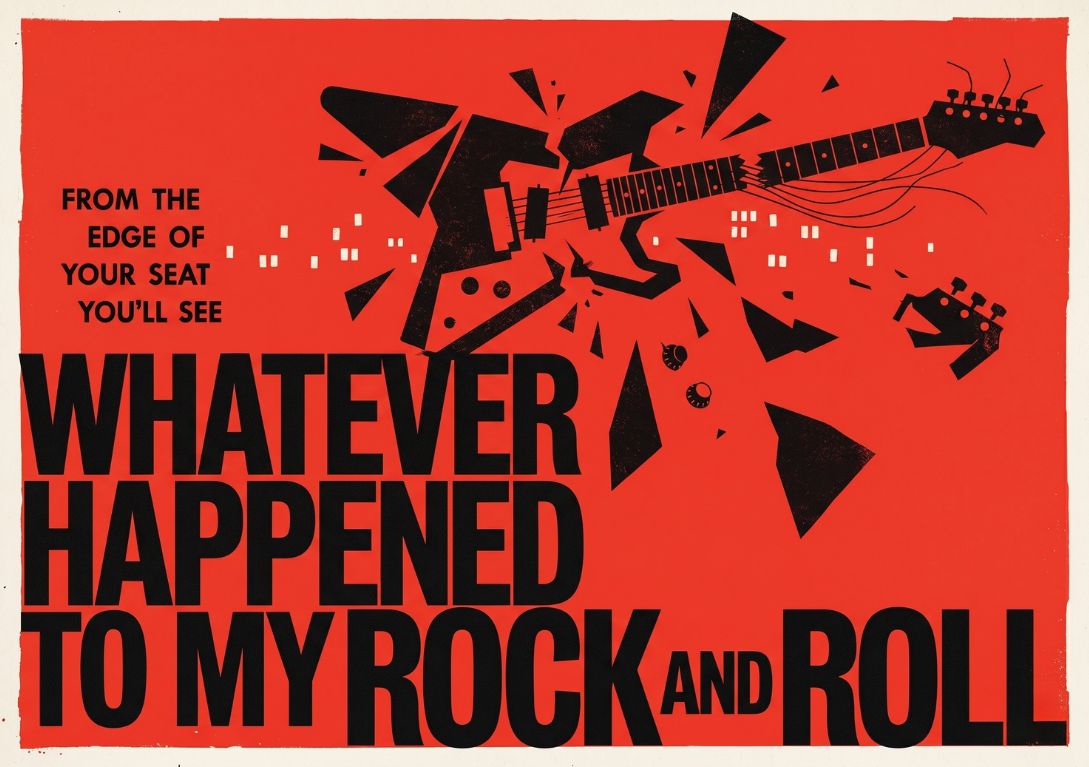
Whatever Happened to My Rock and Roll - Black Rebel Motorcycle Club
I have been paying close attention to how developers and designers are talking about their work in the first half of 2026, and the tone has changed. A year ago, the conversation was about capability. What can AI do? How fast can it ship? What's possible now that wasn't before? That conversation is mostly settled. AI can do a lot. It's fast. The possibility space is huge.
The new conversation is different. People are talking about how the work feels. And what they're describing, over and over, in videos, in posts, in private conversations, is a feeling of loss. They're shipping more than ever. The output is functional. The products work. And something about the whole process feels hollow.
I've been feeling it too. I want to talk about why, and where I think it leads.
I've seen this before, twice
I am a designer, a musician, and a lifelong computer geek. I have been all three since I was a kid. And I have watched the same pattern play out in music and art that is now playing out in software.
In music, the barrier to entry collapsed in stages. First it was affordable home recording. Then digital distribution. Then streaming. Then AI-generated tracks that sound like they were produced in a real studio. Each wave made it easier to create and harder to sustain a living. The number of people making music exploded. The per-unit value of a song cratered. The artists who survived were the ones who couldn't stop making music even when the economics didn't make sense. They did it because they had to. Because the work itself meant something to them. Meanwhile, the lower barrier to entry meant that the sheer amount of music became impossible to curate (and most of it sucked).
In visual design, the same thing happened. Desktop publishing. Stock photography. Canva. Midjourney. Each tool democratized access, which is genuinely good. And each one compressed the market for people who had spent years developing craft, which is genuinely painful. You can now generate a logo in six seconds that would have taken me a week in 1998. It won't be as good. But it will be good enough for most people, and "good enough for most people" is where markets go. "Good enough" sucks.
Now software is getting the same treatment. The barrier to entry just hit the floor. And I'm watching the exact same emotional arc play out among developers and designers that I watched play out among musicians and artists over the past twenty years. The shock. The adjustment. The grief for the loss of what art feels like when you had to overcome struggle to create something genuinely great. And yes, great software is definitely art.
Instant gratification makes the joy of creation go away.
What we actually lost
The old model of working with computers was fundamentally interactive. You had an idea. You sat down. You struggled with the machine to make the idea real. The struggle was the point, not because suffering is virtuous, but because the friction between your intention and the machine's constraints is where you learned. Where you refined. Where the work got better than your original idea, because the process of building it taught you something you didn't know when you started.
That feedback loop, the one where you wrestle with the material and the material wrestles back, is the thing that creates attachment to your work. It's why a cabinet maker runs their hand along a joint they spent an hour fitting. It's why a guitarist plays a solo differently every night even though the recorded version exists. It's why I used to lose track of entire afternoons debugging a prototype and walk away feeling like I'd accomplished something real. Because it WAS something real. The initial idea usually (wait for it) sucked. The fight is what made it not suck.
AI compresses that loop to near zero. You describe what you want. You get it. If it's wrong, you describe it again. The struggle is gone, and with it, the thing that made the work actually good. There is sometimes magic to be found in the one-shot, but there is also magic in winning at a casino or the lottery. But that is the exception, not the norm.
I've caught myself doing something I would have found unthinkable two years ago: YOLO'ing prompts. Just firing off a request, getting back something that looks close enough, and moving on. Not because I don't care about quality. Because the speed is intoxicating, and the output is good enough to pass a quick glance. It's like eating fast food when you know how to cook. You know it's not right. But it's there, and you're hungry, and the effort of doing it properly feels enormous compared to the ease of just accepting what you got.
The problem is that "good enough" accumulates. One YOLO'd prompt is fine. A whole product built on YOLO'd prompts is a hot dog factory. Technically food. Technically functional. But nothing you'd be proud to serve. There is also a ton of real-world risk.
The interface is disappearing
As a UX designer, there's a bigger version of this problem that I keep circling back to.
My entire career has been built on a specific premise: there is a human being on one side of a screen and a system on the other, and my job is to make the space between them work. I've spent decades learning how people interact with interfaces. How they scan. How they get lost. How they build mental models of systems. How to reduce friction, clarify intent, and get them to the outcome they need with the least amount of pain.
But the interface itself is starting to dissolve. The trajectory of computing has always been toward abstraction. Punch cards to command lines to GUIs to touch screens. Each step removed a layer of direct contact between the human and the machine. AI is the next step, and it's a big one. The interaction between human and computer is becoming a conversation with a language model instead of a manipulation of controls.
If that trend continues, and I think it will, then the discipline I've practiced for decades is not disappearing, but it is becoming something I barely recognize. If the user stops interacting with a screen, if the interaction becomes "tell the agent what you want and the agent does it," then we are not designing user interfaces anymore. We are designing outcomes. We are defining what good looks like for a human being, and then letting the systems figure out how to deliver it.
That is a real job. It might even be a more important job than what we've been doing. But it is a profoundly different one, and the transition is disorienting.
Why does it suck?!
There is a version of this post where I pivot to optimism and tell you that everything is going to be fine. I'll get there. But first I want to say the thing that I think a lot of experienced professionals are feeling.
It sucks to watch the thing you spent decades getting good at become a commodity overnight. It sucks to know that the taste, judgment, and craft you developed through years of deliberate practice can now be approximated by someone with a good prompt and thirty minutes. Not matched. Approximated. But the market doesn't always care about the difference.
And it especially sucks when the discourse around it is dominated by two groups that are both wrong. One group says "adapt or die" as if the emotional loss of craft is just a skill issue. The other group says "AI is garbage" and refuses to engage. Neither group is talking about what it actually feels like to be a person with deep skills watching the value of those skills get repriced in real time.
So let me say it again: this is a form of grief. And it is valid. You can grieve the loss of something and still move forward. In fact, you have to do both at the same time, because the world is not going to wait for any of us to finish processing this.
Where the joy comes back
I said at the top that I've watched this play out in music and art. Here's what happened next: I kept making music. I kept designing. I kept loving computers.
The economics of music broke decades ago. I watched it happen. I watched friends leave the profession. I watched the streaming model turn a song into something worth a fraction of a cent. And I kept playing. Simply because the act of making music, of struggling with an instrument, of hearing something come together that didn't exist five minutes ago, of playing for people and feeling the room respond, is irreducible. No AI can generate that experience for me. It can generate a track that sounds like something I might play. It cannot give me the feeling of playing it. And AI can't create the illusive magic of a loud, sweaty rock and roll show.
The same is true for design. I'm building things right now, in April 2026, at a speed that would have seemed absurd two years ago. I built a complete, dynamic brand platform for my wife, who is a life coach and author (KerryPastine.com). She is also an amazing artist who is so prolific that websites could never keep up. Now her art website is also completely dynamic: KerryPastineArt.com. I just add a photo of new piece to a folder, the new code is generated automatically and the website is updated. I am not a developer, I will not claim that the code is production-ready. But it works. It works WELL.
And I am intentionally slowing down at certain stages. I am spending more time reviewing, curating, and refining than I ever have. Because the AI output is good enough to fool you into thinking it's done when it isn't. Also, the uncanny valley is still very real. The effort filter I wrote about in my first blog post is real, and the only way to get it back is to impose it on yourself. You have to choose to care more than the tool requires you to.
That's where the joy comes back for me. I admit, the generation is pretty fun. But the art comes with the struggle: the curation. In the moment where I look at what the machine produced and I make the call: this stays, this goes, this needs to be rebuilt by hand because the AI got the logic right and the feeling wrong. That moment still requires everything I've learned over the past twenty-five years. And it still feels like craft.
What I think comes next
I don't know what UX design looks like in five years. I genuinely don't. The interface might disappear for a lot of use cases. The tools will change again. The economics of creative work will continue to compress in ways that are painful for people who make things for a living.
But humans are going to keep needing things from technology. The question of what those things should be, and whether the technology is actually delivering them, is not going away. When AI can build anything in minutes, the question "should we build this?" becomes the most important question. Yes, it was ALWAYS the important question, but way more now than ever. The people who can answer that question, who can understand real human needs, spot the gap between what was requested and what's actually needed, and say "this is what good looks like," those people are going to matter in the future.
The tools change. The speed changes. The human on the other side of the screen does not.
I wrote that line in my first blog post. I'm going to keep writing it until it stops being true. I don't expect that to happen in my lifetime.
So I'll keep designing. I'll keep playing guitar. I'll keep building things with computers because that is what I have always done, and no model, language or otherwise, can replicate what it feels like to care about the work.
The joy was never in the output. It was in the act of giving a sh*t. That part is ours to keep. Rock and roll.
Paul Shellooe is a Senior Product Designer specializing in enterprise UX and AI strategy, with deep roots in Fortune 500 engineering teams. He is also a musician. Based in Lisbon, Portugal.
Enterprise SaaS
platforms shipped
design rework reduction
Parallels design system
task-flow reduction
Lumen self-serve
0→production
Parallels DaaS
Get in touch
I'm always open to new projects, new ideas, and good conversationsabout design that makes an impact.